


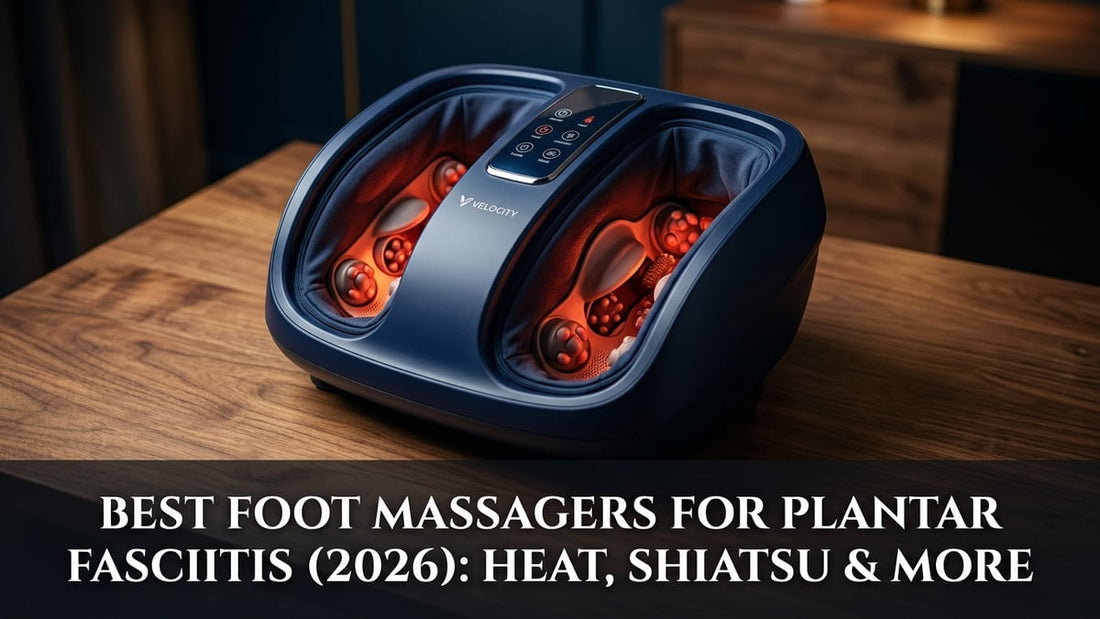
Best Foot Massagers for Plantar Fasciitis (2026): Heat, Shiatsu & More
Soothe heel pain and tight arches with the top-rated foot massagers designed to target plantar fasciitis at its source.
The best foot massager for plantar fasciitis combines genuine contact heat, arch-targeting kneading nodes, and adjustable pressure so you can treat the inflamed fascia daily at home. Shiatsu-style units like the ReAthlete FOOTOASIS and Foottopia address the plantar surface directly, while the Rapid Release Pro3+, operating at approximately 10,000 vibrations per minute, targets fascial adhesions precisely.
- First Steps Hurt Most: Plantar fasciitis pain peaks with those first steps after rest because the fascia tightens overnight, then tends to ease once you have moved around for a few minutes.
- Shiatsu nodes that target the arch directly, combined with heat, replicate enough of what manual physical therapy does that research finds the results comparable to cortisone injections over the medium term.
- 15 to 20 Minutes: Sessions of 15 to 20 minutes, timed before your first morning steps or after the day's loading, consistently outperform longer sessions that offer no added benefit.
- 89 to 120 Dollars Covers the Basics: At the 89 to 120 dollar range you get heat and meaningful kneading, which handles the core requirements; spending more buys additional therapy modes and build quality, not guaranteed faster relief.
- 48 to 72 hours: If swelling and warmth are visible, hold off on heat and kneading for the first 48 to 72 hours and use cold compression instead, as massage can worsen acute inflammation in that window.
Where to start

KoziSense KZ-L66 Luxury Massage Chair 4D + 3D Dual Mechanism

Medical Breakthrough 5 Massage Chair V2.0 - L Track with Reflexology, Zero Gravity & 4D Deep Tissue
Why Plantar Fasciitis Makes Every Step Hurt
Plantar fasciitis is not just foot soreness. It is inflammation of the thick band of connective tissue that runs from your heel bone to the base of your toes, and once it becomes irritated, even getting out of bed in the morning can feel like stepping on gravel.

The pain is usually sharpest with those first steps after a long rest, when the fascia has tightened overnight. It tends to ease once you have walked around for a few minutes, then returns after extended time on your feet. Runners, people who spend long hours standing, and anyone who has gained weight quickly or changed their footwear routine are most commonly affected. Estimates from sports medicine research put the lifetime prevalence at roughly 10 percent of the general population, and among runners the figure climbs higher.
The frustrating part is that it does not resolve quickly on its own. Rest helps, but most people cannot simply stop walking for weeks. That is where targeted massage therapy, heat, and compression come in. These interventions work by increasing blood flow to a tissue that heals slowly because it receives relatively poor circulation, helping break down adhesions, and reducing the mechanical tension on the heel insertion point.
How Foot Massagers Actually Help the Condition
Massage works on plantar fasciitis through a few distinct mechanisms. The kneading and compression of shiatsu-style nodes loosens the fascia itself and the tight calf and arch muscles that pull on it. Improved circulation delivers more oxygen and nutrients to the damaged tissue. Heat, applied directly to the sole, reduces stiffness and raises the pain threshold by relaxing the surrounding soft tissue.

Research on manual physical therapy for plantar fasciitis consistently finds that targeted soft-tissue work reduces pain scores and improves function, often as effectively as cortisone injections over the medium term. An electric foot massager replicates a significant portion of that stimulus and can be used daily at home, which matters because frequency is one of the biggest variables in how quickly the tissue heals.
The key features to look for are heat (genuine contact heat rather than just a warm enclosure), kneading nodes that reach the arch and heel, and enough adjustability so you can modulate pressure on a sensitive day. Vibration or percussion delivered to the sole adds a neurological component that helps dampen pain signals, and compression chambers that wrap the foot can further encourage fluid movement out of inflamed tissue.
The Main Types of Foot Massagers and What Each Does Best
Not all foot massagers are built for the same job. Understanding the categories helps you match the device to your specific pattern of pain.

Shiatsu Kneading Massagers
These use rotating nodes that simulate the thumb-press technique of traditional shiatsu massage. They are the most common style for plantar fasciitis because the nodes can target the arch directly. A good shiatsu unit applies meaningful pressure to the plantar surface rather than just rolling lightly across it. Most include at least one heat setting that warms the foot from the bottom and sides simultaneously.
Compression and Airbag Massagers
Airbag-style massagers inflate chambers around the foot and lower leg in sequences that mimic manual compression. They are excellent for circulation and swelling reduction, which makes them useful for plantar fasciitis that presents with puffiness around the heel or arch. The ReAthlete HEALR takes this principle up a level by combining air compression with both heat and cold therapy on the leg, which can be useful for people who also have calf tightness contributing to their heel pain.
Percussive and Vibration Devices
Handheld percussive massagers, including high-frequency vibration tools, can be applied directly to the arch and heel with a focused attachment. This is a more active approach that requires some technique but allows precise targeting. The Rapid Release Pro3+ operates at approximately 10,000 vibrations per minute, which is designed to work on the shorter cycles associated with scar tissue and fascial adhesions rather than just superficial muscle soreness. It is genuinely useful for plantar fasciitis when applied along the arch toward the heel with moderate pressure, though it takes a little practice to find the right angle.
Combination Units
Several products blend kneading nodes, heat, and compression in a single enclosure. These tend to be the most practical for daily home use because you simply slide your feet in, select a program, and sit back. The tradeoff is that they are larger and less portable than a handheld device.
How the Top Models Compare
The table below covers the core specs most relevant to plantar fasciitis relief. Intensity levels, heat, and therapy type are the deciding factors for most buyers.
| Model | Therapy Type | Heat | Price |
|---|---|---|---|
 ReAthlete FOOTOASIS ReAthlete FOOTOASIS |
Shiatsu kneading | Yes | $99.99 |
 ReAthlete Foottopia ReAthlete Foottopia |
Deep kneading | Yes | $99.99 |
 ReAthlete HEALR ReAthlete HEALR |
Compression + heat + cold | Yes | $119.99 |
 ReAthlete DEXTRA ReAthlete DEXTRA |
Acupressure + vibration | Yes | $149.99 |
 Rapid Release Traveler Rapid Release Traveler |
High-frequency vibration | No | $299 |
 Rapid Release ProAm Rapid Release ProAm |
High-frequency vibration | No | $599 |
The shiatsu-style units like the FOOTOASIS and Foottopia make the most sense for pure plantar fasciitis work because they direct their action at the plantar surface. The HEALR stands out for anyone dealing with concurrent calf tightness, a very common pattern since tight calves increase tension through the Achilles and into the fascia. Percussive tools earn their place as a complement rather than a substitute for an enclosure massager. You may find yourself using one to loosen a specific spot and the other for a broader daily session.
ReAthlete FOOTOASIS and Foottopia: The Everyday Workhorses
Both the FOOTOASIS and the Foottopia are priced at $99.99 and are designed for exactly the use case plantar fasciitis demands: repeated, consistent sessions at home without fuss. The Foottopia offers three distinct intensity levels, which matters more than it might sound. On a bad morning when the fascia is at its most inflamed, the lowest setting lets you get the circulation benefits without aggravating the tissue. On a recovery day after a run, you can push to the highest level for a more therapeutic effect.
The FOOTOASIS pairs its deep kneading action with heat and a remote, which means you can adjust settings without bending over mid-session. For people using a foot massager as part of a nightly wind-down routine, that small convenience adds up. Both units use enclosure-style housings that warm the entire foot, making them practical for the kind of 15 to 20 minute sessions that appear most often in physical therapy protocols for plantar fasciitis.
If you can only own one device for plantar fasciitis relief, either of these two is the most straightforward starting point. They sit in a price range that does not require a major commitment, and the combination of heat and kneading covers the two most evidence-backed mechanisms for fascial relief.
The HEALR: When Calf Tightness Is Part of the Problem
Many cases of plantar fasciitis are at least partly driven by tight calves and a restricted Achilles tendon. When those structures are tense, they transmit additional load to the heel insertion of the fascia with every step. Treating the foot in isolation helps, but addressing the entire posterior chain accelerates recovery noticeably.
The ReAthlete HEALR approaches this differently from a foot-only unit. Its triple therapy model combines air compression, heat, and cold across the leg and foot together. Cold application is genuinely useful on the days immediately following a flare-up, when the goal is reducing acute inflammation rather than stimulating circulation. Heat becomes more useful once the acute phase has settled and you are working on tissue mobility. Having both options in a single device means you are not making a separate purchase for each phase of recovery.
At $119.99 it is only modestly more expensive than the foot-only units. For runners or people who spend long hours on hard floors and regularly experience tightness from the heel up through the calf, that extra coverage is well worth the difference. You can find leg massagers that address this chain comprehensively, but the HEALR does it at a price point accessible to most buyers.
Rapid Release Pro3+: When You Need Precision Over Coverage
The Rapid Release Pro3+ operates on a different principle from a shiatsu enclosure. At approximately 10,000 vibrations per minute, it delivers a very short-stroke, high-frequency vibration that is specifically designed to act on fascial tissue and adhesions rather than on larger muscle groups. That distinction is important for plantar fasciitis because the target is a relatively thin, dense connective tissue band rather than a big muscle belly.
Using it effectively for heel pain means placing the attachment along the arch, working slowly from the ball of the foot back toward the heel, and avoiding direct pressure on the most acutely painful insertion point until the tissue has started to loosen. Most people find a session of five to eight minutes sufficient before combining it with a stretch or a longer heat treatment. The cordless design and included carrying case make it easy to use at a desk or while traveling, which matters for anyone who cannot interrupt their workday to use a plugged-in unit.
The Pro3+ carries a two-year warranty and comes with two batteries, so runtime is not a concern for typical daily sessions. At $999 it is the most significant investment in this category, and the value proposition is strongest for people who are also dealing with muscle soreness, IT band issues, or other soft-tissue problems alongside their plantar fasciitis. If the foot is the only area you are treating, one of the enclosure massagers is more efficient for the money. The detailed breakdown of using percussive tools specifically for heel and arch pain is worth reading before you commit to that approach.
How to Use a Foot Massager Effectively for Plantar Fasciitis
The device is only part of the equation. How and when you use it determines whether you get meaningful relief or just a pleasant sensation that fades in an hour.
Start with a brief warm-up
Use the heat function for the first three to five minutes at a lower intensity before increasing the kneading pressure. Cold, stiff fascia is more vulnerable to micro-trauma if you go in hard immediately.
Time your sessions strategically
A session before your first steps in the morning can meaningfully reduce that initial sharp pain. A session in the evening, after the day's loading, helps the tissue recover overnight. Most people find 15 to 20 minutes sufficient; longer does not necessarily produce better results.
Follow with a calf and arch stretch
Immediately after the massage, while the tissue is warm and pliable, hold a standing calf stretch and a plantar fascia stretch for 30 seconds each. This extends the benefit of the massage by keeping the tissue long rather than allowing it to re-tighten.
Adjust intensity to your pain level that day
On a high-pain day, prioritize heat and gentle compression rather than aggressive kneading. On a lower-pain day, increase the intensity to work deeper into the fascial layer. Forcing through pain during a flare-up slows recovery.
Be consistent over weeks, not days
Plantar fasciitis responds to sustained, repeated stimulus. A single session feels good; three weeks of daily sessions actually changes the tissue. Treat it as a maintenance routine rather than an acute treatment.
What More Money Actually Buys You
The honest answer is that spending more gets you more therapy modes, better build quality, and in some cases a fundamentally different mechanism. It does not guarantee faster relief.
At the $89 to $120 range, you are getting purpose-built foot massagers with heat and meaningful kneading action. That combination handles the core requirements of plantar fasciitis treatment. The ReAthlete line here is well-matched to someone who wants a reliable daily-use unit without overcomplicating the purchase. For anyone also exploring what the broader massage equipment category offers for whole-body recovery, that context helps frame these foot-specific units correctly.
Stepping up to the Rapid Release ProAm at $599 or the Pro3+ at $999 shifts you into professional-grade vibration therapy. You are paying for the specific frequency engineering, the quality of the drive mechanism, and the durability expected from a tool used in clinical settings. For a person with chronic plantar fasciitis that has not responded adequately to lower-intensity approaches, that step up is logical. For someone in the early weeks of their first flare-up, starting with a $99 shiatsu unit is the sensible move. The practical question to ask is whether your foot is the only problem or one of several issues you want to address. The answer changes the calculus on whether a higher-end percussive device earns its price.
Combining a Foot Massager with Other Recovery Tools
A foot massager works better as part of a system than as a standalone intervention. The tissue damage underlying plantar fasciitis involves the whole lower limb kinetic chain, not just the sole of the foot.
People who see the fastest results tend to combine foot massage with calf work, arch strengthening exercises, and footwear correction. If your shoes lack arch support or have a heel drop that stresses the fascia, no amount of massage will outpace the damage being done during eight hours of walking. Orthotic insoles are inexpensive and can dramatically reduce the mechanical load on the fascia between sessions.
For athletes and regular runners, adding a percussive massager to target the calf and Achilles alongside a foot enclosure unit creates a more complete protocol. Studies on percussion therapy in soft-tissue rehabilitation generally find that applying vibration to the muscles attaching to a painful tendon or fascial structure reduces referred tension at the insertion point. That finding transfers directly to plantar fasciitis work. Those interested in percussive therapy for athletic recovery more broadly will recognize the pattern. The foot massagers collection is worth browsing to compare enclosure styles side by side before deciding on a unit.
The combination of a mid-range shiatsu foot massager, consistent daily stretching, appropriate footwear, and a simple strengthening routine for the intrinsic foot muscles addresses every major factor in plantar fasciitis recovery. Any one of those elements alone produces modest results. All four together change the trajectory of the condition meaningfully.
Cases Where a Foot Massager Is Not the Right First Step
Not every person with heel pain should start massaging immediately. If there is active, acute inflammation with visible swelling and warmth, adding heat and kneading in the first 48 to 72 hours can worsen the response. Cold compression and rest are more appropriate in that window.
More massage equipment worth a look

Rapid Release® Pro3+

KoziSense KZ-L66 4D + 3D Luxury Massage Chair | Zero Gravity | SL Track | Thai Stretch | Full Body Massage
Frequently asked questions
Are foot massagers actually effective for plantar fasciitis, or just temporarily soothing?▾
They do more than mask the pain. Kneading and compression increase blood flow to the plantar fascia, which heals slowly because it has relatively poor circulation. Research on manual soft-tissue therapy for plantar fasciitis consistently shows reductions in pain scores and improved function, often comparing favorably to cortisone injections over the medium term, and an electric massager lets you replicate that stimulus daily at home, which is one of the biggest variables in recovery speed.
Who is a good candidate for a foot massager, and who should see a doctor first?▾
Most people with the classic plantar fasciitis pattern, sharp heel pain with the first steps of the morning that eases after a few minutes of walking, will benefit from regular massage and heat. However, if your pain is severe, accompanied by visible swelling and bruising, or has not improved after several weeks of conservative care, see a podiatrist before relying on a massager. Stress fractures and nerve entrapments can feel similar but respond very differently to treatment.
What features matter most when choosing a foot massager for plantar fasciitis?▾
Heat is the most important single feature, specifically contact heat that warms the sole directly rather than just warming the enclosure around your foot. Beyond that, look for kneading nodes that reach the arch and heel rather than just the toes, and enough intensity adjustment so you can dial back pressure on a flare day. Compression chambers that wrap the foot and encourage fluid movement out of inflamed tissue are a useful bonus.
How much does a capable foot massager for plantar fasciitis cost?▾
The range is wide. Shiatsu kneading units with heat like the ReAthlete FOOTOASIS and Foottopia sit at $99.99, while the ReAthlete DEXTRA with acupressure, vibration, and six intensity levels is $149.99. High-frequency vibration devices like the Rapid Release Traveler start at $299 and the ProAm is $599 because they use professional-grade technology. For most people with plantar fasciitis, the $90 to $150 shiatsu-with-heat category covers the core needs well.
How do I set up and use a foot massager for plantar fasciitis safely?▾
Start on the lowest intensity setting for the first few sessions, especially if the arch and heel are actively inflamed. Limit sessions to around 15 to 20 minutes and avoid pressing directly onto a very acutely painful spot for extended periods. If you are using a percussive or vibration device like the Rapid Release Pro3+, work along the arch toward the heel rather than hammering one point, and give yourself a day of lighter use if the area feels more sensitive after a session.
What is the running cost of owning a foot massager?▾
There are no consumables to replace and no recurring subscription costs. The main ongoing consideration is electricity, which for a device in the 50 to 100 watt range used for 20 minutes daily amounts to very little. The ReAthlete DEXTRA and similar units plug into a standard outlet, while the cordless Rapid Release Pro3+ runs on a rechargeable battery included in the package, so even that cost is minimal over time.
How do I choose the right size or type of massager for my feet?▾
Shiatsu enclosure units like the FOOTOASIS are designed for standard adult foot sizes and work for most people, but if you have wide feet or a high arch, check that the node positioning actually reaches your arch rather than just the ball of the foot. The ReAthlete HEALR adds leg compression, which helps if calf tightness is contributing to your heel pain. A percussive device like the Rapid Release Pro3+, operating at approximately 10,000 vibrations per minute, is size-agnostic because you direct it exactly where needed.
What mistakes do people make when using a foot massager for plantar fasciitis?▾
The most common one is going too hard too soon. A heavily inflamed fascia does not respond well to aggressive pressure in the early days, and overdoing it can prolong the flare. The second mistake is using the massager as a substitute for stretching the calf and Achilles, which are major contributors to tension at the heel insertion point. And third, people often give up after a week because improvement feels slow. The tissue heals gradually, and consistent daily use over several weeks is what moves the needle.
Shop massage equipment
Quality inspected before shipping, with expert US-based phone support before and after purchase.
