


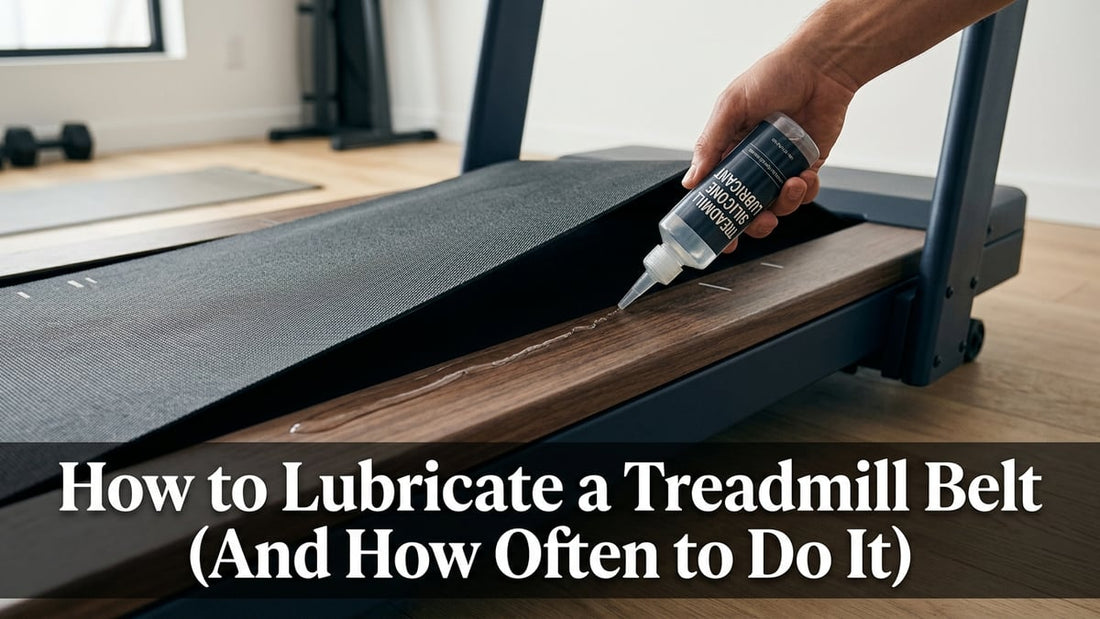
How to Lubricate a Treadmill Belt (And How Often to Do It)
Keep your treadmill running smoothly and quietly with this simple maintenance guide on when and how to lubricate the belt.
Lubricate a motorized treadmill belt every three to six months, or every 150 hours of use, whichever comes first. Heavier use, multiple users, or a dry garage environment pushes that toward the three-month end. Non-motorized curved treadmills and self-lubricating decks follow different rules entirely, check your manual before applying anything.
- Every 150 Hours or Three to Six Months: For most home treadmills, lubrication every three to six months or every 150 hours of use is the standard window, whichever arrives first.
- Self-Lubricating Decks Skip This: Some commercial-grade treadmills have self-lubricating decks that release compound through normal use, and adding silicone on top can actually cause problems.
- Silicone Only, Not WD-40: Pure silicone lubricant is the right choice for virtually every motorized treadmill. WD-40 evaporates, leaves a grit-attracting residue, and makes things worse over time.
- Two to Three Inches of Lift: Correct belt tension lets you lift the belt edge two to three inches off the deck at the midpoint. Less than that is over-tensioned, more is too slack.
- Tying lubrication to a quarterly calendar date or a seasonal task you already do is far more reliable than trying to remember on your own.
Where to start

Pro 6 Arcadia Air Runner Curved Treadmill

SportsArt T676-19 Status Treadmill with 19" SENZA Touchscreen
Why Belt Lubrication Is One of the Most Neglected Maintenance Tasks
Most treadmill problems that look like electrical or motor failures start somewhere much simpler: a dry belt. Friction between the belt and the deck generates heat, and sustained heat degrades the motor, the drive board, and the belt itself. Lubrication is the single maintenance step that addresses all of that at once.

The belt does not run against air. It slides continuously across a deck board, and without a lubricant layer between them, that contact becomes abrasive rather than smooth. Over time a dry belt will begin to slip, then squeal, and eventually the motor starts compensating by drawing more current than it was designed for. That is how a $15 lubrication job turns into a $400 motor replacement.
This applies equally to home units and commercial machines, though the schedule differs considerably. A well-built commercial treadmill with a self-lubricating deck can go longer between applications, while a home model used by one person three times a week still needs attention every few months. The machine does not know how expensive it was. Neglect catches up with both.
How Often to Lubricate a Treadmill Belt
The standard recommendation for most motorized treadmills is every three to six months, or roughly every 150 hours of use, whichever comes first. That window covers the average home user putting in four to five sessions per week. If multiple people use the machine, compress the schedule accordingly because the hours stack faster than you might expect.
Usage intensity matters as much as frequency. A machine used exclusively for brisk walking accumulates far less friction than one used for running intervals, where the belt moves faster and the foot strike lands harder. Heavier users also accelerate wear on the belt-deck interface, so if you are near the upper end of a machine's weight capacity, lean toward the three-month end of that range.
Environmental conditions shift the schedule too. Garages and basements with low humidity or wide temperature swings tend to dry lubricant faster than a climate-controlled room. If you store a treadmill in an unheated space and notice the belt feeling stiff or sluggish on a cold morning, check the lubrication before assuming something mechanical has failed.
Self-Lubricating Decks: When You Can Skip This Step
Some treadmills, particularly at the commercial end of the market, are built with decks that have a wax or silicone compound embedded into the material during manufacturing. Spirit's commercial lineup is a good example: models like the Spirit CT800 and Spirit 4.0T Rehabilitation Treadmill specify self-lubricating decks, which means the deck releases lubricant gradually through normal use rather than requiring scheduled applications from the outside.
On these machines, applying additional silicone lubricant on top of a self-lubricating deck can actually cause problems. Excess lubricant migrates toward the edges, gets picked up by the belt, and can create a slippery surface under the user's feet. If you are unsure whether your deck is self-lubricating, check the manual before doing anything. The manufacturer's maintenance section will specify it clearly.
Non-motorized curved treadmills sit in a completely different category. The Pro 6 Arcadia Air Runner, for instance, uses a near-frictionless belt system by design and does not require the same lubrication routine as a flat-deck motorized machine. The mechanical relationship between the belt and the deck is fundamentally different, and standard silicone lubricant is not the right solution for these units. Again, the manual is the authority here.
The Right Lubricant (and the Wrong Ones)
Pure, 100% silicone lubricant is the correct product for the vast majority of motorized treadmills. It comes in liquid and spray forms, stays stable across a wide temperature range, does not attract dust the way petroleum-based products do, and does not react with the rubber or urethane compounds used in modern belts. This is not a situation where you improvise with what is on the shelf.
WD-40 is probably the single most common wrong answer. People reach for it because it is already in the garage and works on squeaky hinges. On a treadmill deck it will initially reduce friction, then evaporate, leave a residue that attracts grit, and ultimately make the problem worse. Petroleum-based lubricants in general degrade belt materials over time and voids most manufacturer warranties the moment they are detected.
Paraffin wax was the standard lubricant before silicone became widely available, and some older machines still specify it. If your manual lists wax, use wax. Mixing lubricant types by switching mid-ownership is not recommended because residue from one product can interact unpredictably with another. When in doubt, contact the manufacturer or the dealer before switching products.
How to Apply Lubricant: The Correct Method
Power down completely
Turn the machine off and unplug it from the wall. On machines with a magnetic safety key, remove the key. You will be reaching under the belt, and this step is not optional. Give the belt thirty seconds to come to a complete stop before touching it.
Loosen the belt slightly if needed
You need to be able to lift the belt edge far enough to slide a bottle nozzle or applicator underneath. Most belts allow this without any adjustment. If yours is tensioned too tight to lift, loosen the rear roller bolts by a quarter turn on each side, equally, before proceeding.
Apply lubricant to the centre of the deck
Lift the left edge of the belt and apply lubricant in a Z-pattern or S-pattern across the centre of the deck surface, from one side to the other. Repeat on the right side. You want to cover the centre third of the deck width, which is the zone that takes the most traffic. Aim for one to two ounces total; more is not better.
Spread it with a walking session
Plug the machine back in and walk on it at a slow speed (2 to 3 mph) for three to five minutes before running. This distributes the lubricant evenly across the deck surface and works it into the contact area. The belt will feel marginally smoother by the end of this break-in walk.
Wipe the edges and re-tension if adjusted
Any lubricant that has migrated to the belt edges or handrail area should be wiped away with a dry cloth. If you loosened the rear roller, re-tension both sides equally until the belt tracking is centred and there is no lateral drift.
Signs Your Belt Needs Lubrication Now
The clearest warning sign is a high-pitched squeal that starts when you begin running and eases off as the belt warms up. That pattern specifically points to a dry deck-belt interface rather than a mechanical failure, because friction produces heat and heat temporarily loosens the contact. If the sound stops after five minutes but returns the next day, lubrication is almost certainly the fix.
Belt slippage under load is another common indicator. You feel a brief hesitation or stutter when your foot pushes back, as though the belt is not quite keeping pace with your stride. Before blaming the motor or the drive belt, check the lubrication. A dry running surface increases the resistance the motor works against, and slippage is often the motor struggling rather than failing.
A noticeable increase in console-reported power draw, or in some machines an error code related to motor load, can also trace back to a dry belt. The motor is drawing more current because friction is fighting it. On machines like the SportsArt G690 Verde, which actively tracks the energy being generated by the runner, an unexplained change in watt output can sometimes signal increased mechanical resistance on the deck side.
Finally, there is the tactile test described above. If the underside of the belt feels dry, rough, or slightly sticky when you rub it against the deck surface, that is enough to justify lubrication even if the machine is running quietly. Prevention is considerably cheaper than repair.
Belt Tension and Alignment: What Goes Hand in Hand
Lubrication is most effective when the belt is correctly tensioned. A belt that is too tight creates more friction against the deck regardless of how well-lubricated it is, because the contact pressure is higher than it should be. A belt that is too loose slips at the drive roller end, which produces its own kind of wear. The two adjustments are related, and good maintenance practice addresses both at the same session.
Correct tension allows you to lift the belt edge about two to three inches off the deck at the midpoint. Less than that and it is over-tensioned; more and it is slack. Adjustment is made at the rear roller, using the bolts on either side of the frame, and the key is equal turns on both sides to keep the belt centred. Uneven adjustment pulls the belt toward one side and causes edge wear that no amount of lubrication can fix.
For home users running regular maintenance, combining a lubrication application with a tension and alignment check once every three months takes about fifteen minutes total and covers the two most common sources of premature belt failure. The treadmills suited to home use vary considerably in how accessible their rear roller adjustments are, so it is worth checking where those bolts sit before you need to reach them in a hurry.
Maintenance Considerations for Commercial-Grade Machines
Commercial treadmills used in a home gym setting present an interesting maintenance case. The machines are built for multi-user environments with professional servicing schedules, but a single household user will accumulate hours far more slowly than a gym floor does. That means lubrication intervals stretch out, but it also means you may go months without thinking about the machine at all, which is its own risk.
The Spirit CT800, which weighs 350 pounds and is rated for continuous commercial use, specifies a self-lubricating deck that eliminates the need for periodic silicone applications. That is a genuine convenience for a home gym owner who does not want to track maintenance schedules. The trade-off is that the deck is part of the unit's cost basis, and replacing it when it eventually wears through is a more involved service call than a tube of lubricant.
Motorized commercial machines with conventional decks, like the Inflight Fitness M6, use a lubricant-infused thermoplastic polyurethane belt designed to reduce but not eliminate the need for periodic maintenance. For a commercial setting with high daily use, the facility would schedule professional servicing. For a home gym, the owner inherits that responsibility and should ask the dealer for a specific maintenance schedule at the time of purchase.
If you are deciding between a home-grade unit and a commercial machine for personal use, the differences in build quality and running costs extend well beyond the purchase price, and maintenance complexity is part of that picture. You can browse the full range of treadmills at Peak Primal Wellness to compare models side by side.
Curved and Non-Motorized Treadmills: A Different Maintenance Conversation
Curved non-motorized treadmills like the Pro 6 Arcadia Air Runner are powered entirely by the user's movement, which means there is no motor to protect from friction-related overload. The maintenance priorities shift accordingly. The belt system on these machines is engineered for minimal friction from the outset, and the manufacturer's documentation specifies what, if anything, needs periodic attention.
The SportsArt G690 Verde takes a similar approach as a non-motorized unit, and adds an electrical braking system to the mix. Its flat-slat belt design is quite different mechanically from a conventional rubber belt running over a deck board, so standard silicone lubrication advice does not transfer directly. SportsArt does not publish a consumer-facing lubrication schedule for the Verde; maintenance on this machine is better handled through a qualified service contact.
For anyone drawn to curved treadmills for their training benefits, understanding how they differ from flat-deck machines in terms of mechanics and maintenance is useful background before purchasing. The lower long-term maintenance burden is often cited as a practical advantage of self-powered designs, though the higher purchase price reflects that engineering.
Building a Maintenance Routine That Actually Gets Done
The reason treadmill lubrication gets skipped is almost never ignorance. Most owners know it is something they should do. The problem is that three months passes quietly, nothing obvious goes wrong, and the task slips another three months. By the time the squeal starts, the belt has been running dry for longer than it should have.
The simplest fix is to tie lubrication to something that already happens on a schedule. Some people use the first of every quarter. Others attach it to a seasonal task like changing an HVAC filter. The specific anchor does not matter as much as the fact that it is external and automatic rather than dependent on remembering.
Keeping a short maintenance log for the machine is also useful, particularly if it is a commercial-grade unit with a longer service history. A note on your phone with the date of the last lubrication, the lubricant used, and any tension adjustments made takes thirty seconds and saves a lot of guesswork later. If the machine develops a problem and needs professional service, that log is also the kind of thing a technician will ask about.
Anyone deciding between a treadmill and another form of cardio equipment should know that comparable maintenance considerations apply across the category. An exercise bike, for instance, has its own upkeep requirements but generally simpler ones, which sometimes factors into the purchase decision for people who prefer low-maintenance equipment. If walking at an incline is a core part of your training plan, the cardiovascular and metabolic case for incline work is also worth understanding before you settle on a machine. Exercise bikes are a popular cross-shop option, and you can browse the exercise bikes collection for context on what else is available.
When Lubrication Is Not Enough
There are situations where lubrication will not resolve the problem, and continuing to apply it can mask a failure that needs actual repair. If the belt is visibly fraying at the edges, pilling on the underside, or has developed a permanent curl or crease, the belt needs replacement, not more lubricant. Running a damaged belt will transfer that damage to the deck and potentially to the drive system.
Persistent slippage after fresh lubrication and correct re-tensioning usually points to a stretched or worn drive belt rather than a deck issue. The drive belt connects the motor pulley to the front roller and is a separate component from the running belt. On a well-used machine this can stretch over time, particularly on units that see a lot of high-speed running. A technician can diagnose and replace it without a full service overhaul.
Motor overheating that continues after a lubrication service warrants a professional look. The motor itself may have accumulated debris internally, the cooling fan may be blocked, or the control board may have a fault developing. These are not DIY repairs on a machine of significant value, and most manufacturer warranties have explicit terms about unauthorized internal repairs voiding coverage.
A well-maintained belt running on a properly lubricated deck is the best insurance a treadmill owner has against these larger costs. The time investment is minimal. Three months goes by fast, but fifteen minutes of basic maintenance at the right interval is all the difference between a machine that runs cleanly for a decade and one that needs a service call in its third year.
More treadmills worth a look

SportsArt G690 Verde Status ECO-POWR Treadmill

SportsArt T674-16 Elite Treadmill with 16" SENZA Touchscreen
Frequently asked questions
How often should I lubricate a treadmill belt?▾
For most motorized treadmills, every three to six months or roughly every 150 hours of use is the standard recommendation, whichever comes first. If multiple people share the machine, the hours stack faster, so check more frequently. Heavier users or those doing high-intensity intervals should lean toward the three-month end of that range rather than waiting the full six.
Is my treadmill safe to skip lubrication if it feels fine?▾
A quick check is more reliable than feel alone. Lift the belt edge halfway along its length, slide your fingers underneath, and press against the deck. It should feel slightly slick, similar to a light wax coating. If it feels dry or rough, lubrication is overdue regardless of when you last applied it, because a dry belt can silently overwork the motor long before you notice any performance change.
What does a missed lubrication actually cost me?▾
A bottle of 100% silicone lubricant is around $10 to $15. The motor or drive board damage that results from sustained friction on a dry belt can run to several hundred dollars in parts alone, not counting labour. The article makes the point clearly: a neglected lubrication schedule is one of the most common reasons a treadmill that looks like it has an electrical problem actually has a much simpler underlying cause.
Do I need to lubricate a non-motorized or curved treadmill?▾
No, at least not in the same way. The Pro 6 Arcadia Air Runner uses a near-frictionless belt system by design, and its mechanical relationship between belt and deck is fundamentally different from a flat-deck motorized machine. Standard silicone lubricant is not the right solution for these units. Always check the manual first, because applying the wrong product to the wrong machine can cause more harm than skipping lubrication entirely.
What lubricant should I use, and what should I avoid?▾
Pure 100% silicone lubricant, either liquid or spray, is correct for the vast majority of motorized treadmills. It stays stable across temperature ranges, does not attract dust, and does not degrade belt materials. WD-40 is the most common wrong answer: it reduces friction briefly, then evaporates, leaves a residue that collects grit, and can void a manufacturer warranty. Petroleum-based lubricants in general are a poor choice for treadmill decks.
How do I actually apply treadmill belt lubricant correctly?▾
Power the machine off, unplug it, and remove the safety key before doing anything. Lift the left edge of the belt and apply lubricant in a Z-pattern or S-pattern across the centre of the deck, then repeat on the right side. After applying, run the belt at a slow speed for a minute or two to spread the lubricant evenly before using the machine for a full workout.
Do self-lubricating decks still need periodic silicone applications?▾
No, and adding lubricant to a self-lubricating deck can actually cause problems. The embedded wax or silicone compound releases gradually through normal use, and applying additional product on top can cause excess lubricant to migrate toward the belt edges and create a slippery surface underfoot. Check the maintenance section of your manual before applying anything. If it specifies a self-lubricating deck, leave it alone.
What are the most common mistakes people make when lubricating a treadmill?▾
The biggest ones are using the wrong product (WD-40 and petroleum-based lubricants top the list), skipping the power-down step before reaching under the belt, and applying lubricant on top of a self-lubricating deck that does not need it. Another common error is assuming a scheduled interval is more reliable than a physical check. The deck can dry out faster in a garage or basement with low humidity or wide temperature swings, so environment matters as much as a calendar reminder.
Shop treadmills
Quality inspected before shipping, with expert US-based phone support before and after purchase.
