

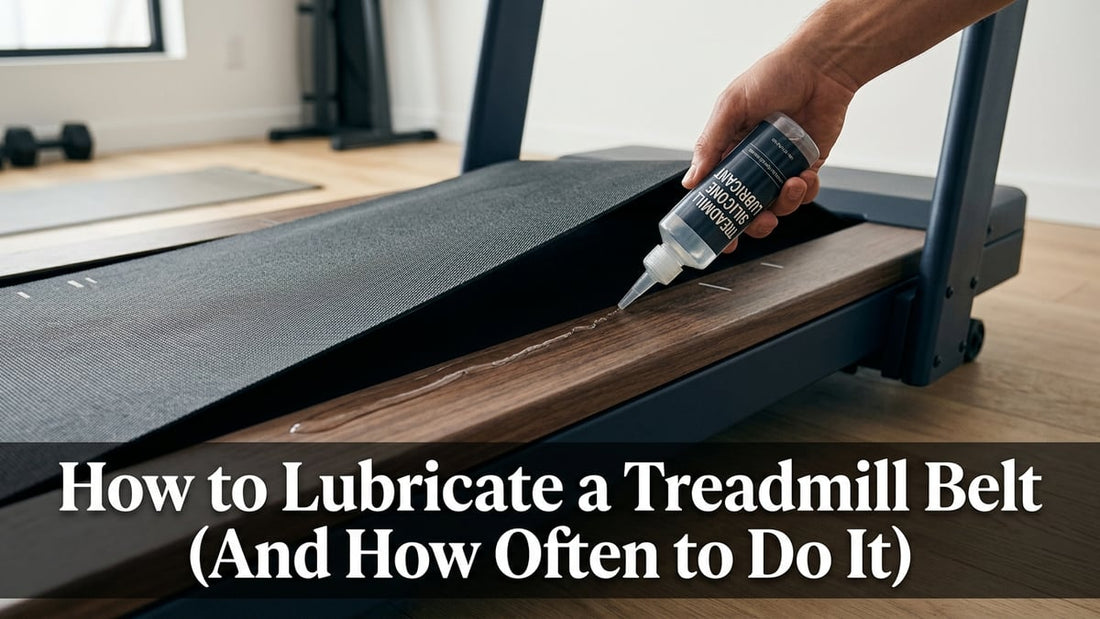
How to Lubricate a Treadmill Belt (And How Often to Do It)
Keep your treadmill running smoothly and quietly with this simple maintenance guide that extends the life of your machine.
Key Takeaways
- Lubrication frequency: Most treadmills need lubrication every 3 months or every 130–150 miles, whichever comes first.
- Lubricant type matters: Always use 100% silicone-based lubricant — never WD-40, petroleum-based oils, or general-purpose sprays.
- Signs of a dry belt: Squeaking, stiffness, motor strain, or a burning smell are clear signals that lubrication is overdue.
- Simple process: The entire lubrication job takes under 10 minutes and requires no special tools or mechanical experience.
- Extends machine life: Regular lubrication reduces friction on the motor, deck, and belt — dramatically extending the lifespan of your treadmill.
- Check your manual first: Some modern treadmills are pre-lubricated or self-lubricating — applying lubricant to these can actually cause damage.
📖 Go Deeper
Want the full picture? Read our The Ultimate Guide to Treadmills for everything you need to know.
Top Treadmills Picks
Premium quality with white-glove delivery included, pre-delivery inspection, and expert support.

Steelflex PT10 Commercial Rehabilitation Treadmill
$7,620
- ✅ White-Glove Delivery Included
- ✅ Commercial-Grade Build
- ✅ Free Shipping Included
- ✅ Ongoing Expert Phone Support

Fitnex T65D Treadmill
$3,100
- ✅ White-Glove Delivery Included
- ✅ Free Shipping Included
- ✅ Expert US-Based Support
- ✅ Ongoing Expert Phone Support

Fitness XT5 Kids Treadmill
$1,938
- ✅ White-Glove Delivery Included
- ✅ Free Shipping Included
- ✅ Expert US-Based Support
- ✅ Ongoing Expert Phone Support

Fitnex T70 Treadmill
$3,888
- ✅ White-Glove Delivery Included
- ✅ Built-In Audio System
- ✅ Active Cooling System
- ✅ Ongoing Expert Phone Support
Why Lubricating Your Treadmill Belt Actually Matters
Your treadmill belt is in near-constant contact with the running deck, and that friction adds up fast. Every footfall pushes the belt against the deck surface, and without an adequate lubricant layer between them, that friction generates heat, resistance, and wear on both components. Over time, an unlubricated belt forces your motor to work harder to maintain speed — and motors that run hot and strained don't last nearly as long as they should.
Research into treadmill maintenance consistently shows that regular lubrication is one of the single highest-impact things you can do to protect your investment. A well-maintained belt reduces motor amp draw, keeps the running surface consistent underfoot, and prevents the kind of component degradation that leads to expensive repairs. In short, skipping lubrication is one of the most common — and most avoidable — causes of premature treadmill failure.
Beyond protecting the machine, a properly lubricated treadmill also delivers a noticeably better workout experience. The belt runs smoother, your pace stays more consistent, and you eliminate the annoying squeaks and stutters that develop when friction builds up. It's a small maintenance task with outsized returns.
What You'll Need
The good news is that lubricating a treadmill belt requires almost no equipment, and what you do need is inexpensive and widely available. Before you begin, gather the following:
- 100% silicone treadmill lubricant: This is non-negotiable. Look for a product specifically labeled for treadmill use. It typically comes in a squeeze bottle with a narrow applicator tip, which makes it easy to apply under the belt.
- A clean lint-free cloth: You'll use this to wipe down any residue from the belt surface before and after application.
- Your treadmill's owner manual: This confirms the specific lubrication schedule, lubricant type, and access method recommended by your manufacturer.
- Mild soap and water (optional): Useful for cleaning the belt surface if there's significant buildup of dust, debris, or old lubricant before you apply a fresh coat.
Most treadmill lubricants are sold in bottles ranging from 4 to 8 ounces, and a single bottle will typically last through multiple applications. Expect to spend between $8 and $20 for a quality product. Some treadmill manufacturers sell their own branded lubricant, and using that can be a straightforward way to ensure compatibility — but any reputable 100% silicone treadmill lubricant will generally work.
How Often Should You Lubricate a Treadmill Belt?
Frequency depends on how often you use your treadmill, the environment it lives in, and the specific model you own. As a general rule, most treadmills benefit from lubrication every 3 months or approximately every 130–150 miles of use — whichever milestone arrives first. If you're a daily runner logging significant mileage, you may need to lubricate more frequently than once a quarter.
- Light use (1–3 days/week, walking pace): Every 4–6 months is typically sufficient.
- Moderate use (3–5 days/week, mixed walking and running): Every 3 months or 130 miles.
- Heavy use (daily runner, high mileage): Every 6–8 weeks, or after every 50–75 hours of use.
- Dry or dusty environments: Increase frequency slightly, as dry air and particulate matter accelerate lubricant breakdown.
Some newer treadmill models — particularly higher-end machines — come with self-lubricating belts or pre-applied lubricant systems that require little to no user maintenance. If you own one of these, applying additional lubricant can actually cause problems by oversaturating the belt and making it slippery or causing it to slip on the deck. Always check your owner's manual before beginning any lubrication routine on a new machine.
How to Lubricate a Treadmill Belt: Step-by-Step Instructions

The process is straightforward and takes less than 10 minutes from start to finish. Follow these steps carefully for the best results.
Step 1: Power Off and Unplug the Treadmill
Safety first. Before you do anything, press the stop button, then turn the treadmill off using the power switch, and unplug it from the wall outlet. Never attempt to lubricate a moving or powered treadmill. This protects both you and the machine.
Step 2: Check Your Owner's Manual
Before reaching for the lubricant bottle, take two minutes to review your treadmill's manual. Confirm the recommended lubricant type, the preferred application method, and the belt access points specific to your model. Some treadmills have side-access points rather than a lifted belt, and knowing this in advance makes the process faster and cleaner.
Step 3: Loosen the Belt Slightly (If Needed)
For most consumer treadmills, you'll need to create a small gap between the belt and the running deck to get the lubricant applicator underneath. Use a hex key (Allen wrench) — typically 4mm or 6mm — to slightly loosen the rear roller adjustment bolts on both sides of the treadmill. Turn each bolt counterclockwise by the same number of turns (usually half a turn each side) so the belt tension is reduced evenly. You're not trying to remove the belt, just create enough space to slide the applicator nozzle underneath. On many machines, you can skip this step entirely and simply lift the belt edge by hand.
Step 4: Clean the Belt and Deck Surface
Before applying fresh lubricant, wipe down the underside of the belt and the top of the deck with a clean, slightly damp cloth. This removes accumulated dust, old dried lubricant, and debris that can contaminate the new application. Allow the surfaces to dry fully before proceeding — applying lubricant over moisture can reduce its effectiveness and cause uneven distribution.
Step 5: Apply the Lubricant
Lift one side of the belt and insert the applicator nozzle of your silicone lubricant bottle approximately 3–4 inches under the belt, toward the center of the deck. Apply lubricant in a slow, sweeping Z-pattern or side-to-side line across roughly the middle third of the deck — this is the area that experiences the most contact during walking and running . Repeat on the other side. Most manufacturers recommend using about 1 ounce (roughly half the bottle cap) per application, though your manual may specify a different amount. Resist the urge to over-apply — excess lubricant can cause the belt to slip and can attract grit and debris.
Step 6: Re-Tension the Belt
If you loosened the rear roller bolts in Step 3, retighten them now — the same number of turns on each side. Proper belt tension is critical: a belt that's too loose will slip under load, while one that's too tight will strain the motor and rollers. As a general rule, you should be able to lift the center edge of the belt about 2–3 inches off the deck when it's correctly tensioned. If you're unsure, consult your manual for the manufacturer's specific tension guidelines.
Step 7: Spread the Lubricant by Walking the Belt
Plug the treadmill back in, power it on, and set it to a slow walking speed — around 2–3 mph. Walk on the treadmill for approximately 2–3 minutes. This distributes the silicone lubricant evenly across the full length of the deck and belt contact surface. After walking, step off, power the machine down, and wipe away any lubricant that may have spread to the top surface of the belt with a dry cloth. A small amount of surface transfer is normal; a large wet patch suggests over-application.
Step 8: Log the Date
This step is easy to skip but genuinely useful. Write the date of lubrication on a piece of tape inside the treadmill's side rail, or note it in your phone. Knowing when you last lubricated helps you stay on schedule and takes the guesswork out of future maintenance.
Common Lubrication Mistakes to Avoid
Even a simple maintenance task has its pitfalls. These are the mistakes that most commonly cause problems — and how to avoid them.
- Using the wrong lubricant: As mentioned above, petroleum-based products, WD-40, and general sprays will damage belt and deck materials. Always use 100% silicone lubricant designed for treadmills.
- Over-lubricating: More is not better. Excess lubricant causes belt slippage, which is both dangerous and damaging to the motor. Apply only the recommended amount.
- Lubricating a self-lubricating treadmill: Adding lubricant to a machine that already has a factory-applied system can oversaturate the belt and create slippage hazards. Always confirm your model's requirements first.
- Skipping belt cleaning before reapplication: Layering new lubricant over old, dried residue and dust reduces the effectiveness of the application and can cause uneven friction.
- Only lubricating one side: The lubricant needs to reach the center of the deck. Applying only from one edge means the other half of the belt contact zone remains dry.
- Forgetting to re-tension the belt: If you loosened the belt for access, failing to restore proper tension before running the machine can cause belt slippage and premature wear.
Treadmill Belt Maintenance Beyond Lubrication
Lubrication is the most critical regular maintenance task for a treadmill, but it works best as part of a broader upkeep routine. Combining it with a few other simple habits will keep your machine running smoothly for years.
- Belt alignment checks: Periodically check that your belt is tracking straight and centered on the deck. A drifting belt wears unevenly and puts stress on the rollers. Most treadmills have rear roller adjustment bolts that allow you to correct drift — tighten the bolt on the side the belt drifts toward by a quarter turn at a time until it tracks true.
- Regular vacuuming: Dust and debris accumulate under and around the treadmill motor cover. Every 1–3 months, remove the motor cover and use a vacuum or compressed air to clear out lint and dust. Dust buildup around the motor is a genuine fire risk in high-use environments.
- Belt tension monitoring: Check belt tension every few months, especially if you use the treadmill frequently. A belt that has stretched or loosened over time will slip under load, stressing the motor and creating an inconsistent running surface.
- Using a treadmill mat: Placing a rubber equipment mat beneath your treadmill reduces vibration, protects your floor, and significantly reduces the amount of dust and carpet fibers that get pulled into the motor and belt area.
- Belt replacement: Even with excellent maintenance, belts eventually wear out. Signs that replacement is due include visible fraying at the edges, a glazed or shiny underside surface, or persistent slippage even after proper lubrication and tensioning. Most quality treadmill belts last 5–10 years with regular maintenance.
Final Thoughts
Learning how to lubricate a treadmill belt correctly is one of the easiest and most valuable things you can do as a treadmill owner. It takes less than 10 minutes, costs next to nothing, and pays dividends in the form of a quieter, smoother machine with a dramatically extended service life. The motor works less , the belt wears more evenly, and you get a more consistent workout experience every time you step on.
The key principles to keep in mind: use only 100% silicone lubricant, apply it to the underside of the belt at the deck contact zone, don't over-apply, and stay on a regular schedule based on your usage level. If you're unsure about anything — particularly whether your model has a self-lubricating system — your owner's manual is always the authoritative source.
Treat your treadmill like the significant investment it is, and it will return the favor with years of reliable performance. Building a simple quarterly maintenance habit — lubrication, belt check, motor area vacuuming — takes less than 20 minutes total and is genuinely the difference between a machine that lasts a decade and one that needs expensive repairs or replacement in three years.
Frequently Asked Questions
How often should you lubricate a treadmill belt?
Most treadmills should be lubricated every three to six months, or approximately every 150 miles of use — whichever comes first. However, if you run in a hot or dry environment, you may need to lubricate more frequently since heat and low humidity cause lubricant to break down faster.
What type of lubricant should I use on a treadmill belt?
The vast majority of treadmills require 100% silicone-based lubricant, which is specifically designed to be safe for the belt and deck materials. Avoid using WD-40, petroleum-based oils, or general-purpose sprays, as these can degrade the belt, void your warranty, and potentially damage the motor.
How do I know if my treadmill belt needs lubrication?
Common signs that your treadmill belt needs lubrication include a squeaking or squealing noise during use, a burning smell, increased motor strain, or a belt that feels rough or jerky underfoot. You can also do a simple touch test — slide your hand under the belt and if the underside feels dry or rough rather than slightly slick, it's time to lubricate.
Is it safe to lubricate a treadmill belt yourself, or should I hire a technician?
Lubricating a treadmill belt is a straightforward maintenance task that most owners can safely perform at home in under 15 minutes with no special tools required. You only need to call a technician if you notice more serious issues like belt slippage, misalignment, or motor problems that lubrication alone won't resolve.
How much silicone lubricant do I need to apply?
Typically, you only need about half an ounce — or roughly 10 to 15 ml — of silicone lubricant applied in a zigzag pattern across the center of the deck under the belt. Applying too much lubricant is a common mistake and can cause the belt to become slippery or attract dust and debris, which speeds up wear.
Do I need to loosen the treadmill belt before lubricating it?
Yes, in most cases you will need to slightly loosen the rear roller bolts to lift the belt edge enough to apply lubricant underneath it on both sides. You don't need to fully remove or detach the belt — just enough slack to slide the applicator nozzle or your hand beneath each side comfortably.
How long should I wait after lubricating before using the treadmill?
After applying lubricant, you should run the treadmill at a slow speed — around 3 mph — for two to three minutes with no one on it to help distribute the lubricant evenly across the deck surface. Most manufacturers recommend waiting at least five minutes before resuming your normal workout to allow the silicone to fully spread and settle.
How much does treadmill belt lubricant cost, and where can I buy it?
A bottle of 100% silicone treadmill lubricant typically costs between $8 and $20 and is widely available at sporting goods stores, home improvement retailers, and online marketplaces like Amazon. One bottle usually contains enough lubricant for several applications, making it a very cost-effective way to extend the life of your treadmill and avoid expensive repairs.
Continue Your Wellness Journey
Best Treadmills for Home Use
Find the best treadmill for home use. Expert-tested picks compared by motor power, incline range, build quality, and long-term durability.
Best Treadmills for Running (Not Just Walking)
The best treadmills for running need more than a fast belt. We compare motor power, cushioning, incline, and durability for serious runners.
Best Commercial Treadmills for Home Gyms
Looking for a commercial-grade treadmill for your home gym? We compare the top semi-commercial and commercial models for durability and performance.
