


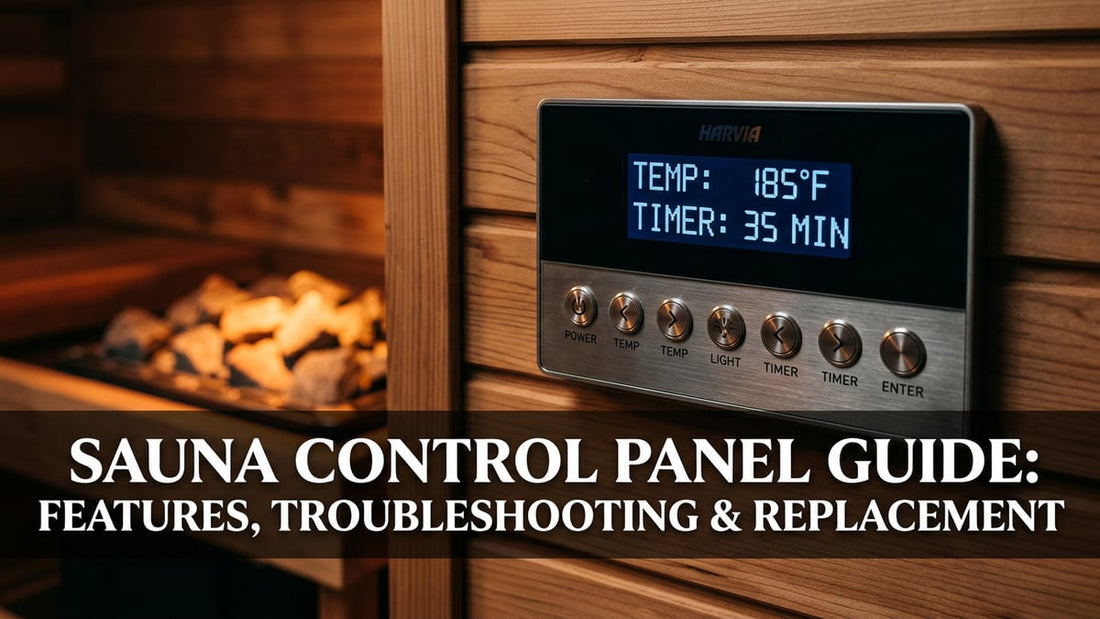
Sauna Control Panel Guide: Features, Troubleshooting & Replacement
Master your sauna's control panel with expert tips on key features, common fixes, and when it's time for a replacement.
A sauna control panel regulates temperature, manages session timers, triggers auto-shutoff, and in advanced units like the HUUM UKU Wi-Fi system, enables remote scheduling via smartphone. Built-in versions, found on heaters like the Harvia KIP60B and KIP80B, handle these functions directly on the unit without a separate wall-mounted cable run.
- Panel Controls the Whole Session: Your control panel does more than set temperature; it manages session timing, safety shutoffs, and on newer units, remote access through a smartphone app.
- Built-In vs. Separate Panel: Built-in controls simplify installation, but a separate wall panel gives you easier access and makes replacement simpler if something fails down the road.
- 240V Dedicated Circuit Required: Almost every residential electric sauna heater runs on 240V and needs its own dedicated breaker, so check your electrical panel for a spare slot before buying anything.
- Match Panel to Exact Model: Control panels are not interchangeable across a manufacturer's range, so start with the model number on your heater body and confirm compatibility before ordering a replacement.
- Loose Cable Mimics Full Failure: Before assuming the panel is dead, reseat the control cable at both ends; vibration from heating cycles works plugs loose and produces symptoms that look like a complete failure.
Where to start

Harvia KIP80B KIP Series 8kW Black with Heater Built-In Controls Electric Sauna Heater

HUUM HIVE 18.0kW Sauna Heater Package With Wi-Fi Control For Large Spaces
What a Sauna Control Panel Actually Does
The control panel is the interface between you and your heater. It sets temperature, manages session length, handles safety shutoffs, and in many modern units, connects your sauna to a smartphone app. Understanding what yours does, and what it should do, makes every other decision clearer.

At a basic level, a sauna control panel reads the ambient temperature inside the room, compares it to your target, and tells the heating elements to cycle on or off accordingly. On a traditional electric heater, that process happens through a simple thermostat and a mechanical timer. On a more sophisticated unit, a digital controller manages all of that plus safety features like auto-shutoff, overheat protection, and remote scheduling. The hardware doing the work is the heater; the panel is just the brain giving it instructions.
The practical difference between a basic panel and an advanced one shows up most clearly in daily use. A manual dial gives you a temperature range and a countdown. A digital panel with a backlit display lets you set a precise target, program a delayed start so the room is ready when you are, and check the current temperature without opening the door. These are not luxury extras. After a few months of regular sauna use, being able to schedule a session from your phone while you finish dinner stops feeling like a novelty and starts feeling like the obvious way to do it.
Built-In Controls Versus Separate Control Panels
The first choice you will face is whether your heater has controls integrated into the unit itself or mounts a separate panel on the wall. Both configurations are common, and neither is inherently superior. The distinction matters mainly for installation and for what happens when something goes wrong.

Heaters with Built-In Controls
Several Harvia KIP Series heaters are a good example of this approach. The KIP60B and KIP80B models in both stainless and black steel finishes mount the control panel directly on the heater body. You get a thermostat adjustment and a timer, including a delayed start feature, all without running a separate control cable through the wall. This keeps installation simpler and reduces the number of components that can fail independently. The tradeoff is that the panel is mounted at heater height, which puts it low on the wall and, in a compact sauna, potentially close to the bench. Some users find reaching down to adjust settings mid-session less convenient than a panel positioned at a comfortable height on a wall near the door.
The Harvia KIP80B, for instance, is rated for rooms from 250 to 425 cubic feet and carries a 44-pound stone capacity. Its built-in controls cover everything most home sauna users need: temperature setting, session timer, and auto-shutoff. For a straightforward home installation, this setup is hard to beat on value and simplicity.
Heaters with Separate Control Panels
Larger or more performance-oriented heaters typically require a separate wall-mounted control panel, connected to the heater by a dedicated cable. Harvia's Xenio series panels work this way, pairing with higher-output models like the Virta and Club lines. The panel mounts near the door at a comfortable height, while the heater sits wherever the room layout demands. Some panels in this category also support lighting and ventilation controls, making them the central hub for the entire sauna experience rather than just the heater.
HUUM takes a similar approach with its UKU control system. The UKU panel pairs with HUUM heaters across the range, from compact 6 kW units to the 18 kW HIVE. What makes this pairing notable is that the UKU is available in a Wi-Fi version, letting you preheat and schedule sessions through a smartphone app. The HUUM HIVE 18 kW package includes the UKU Wi-Fi controller as part of the kit, which is worth factoring in when comparing prices across brands, since you are not paying extra for a separate accessory.
If you are browsing sauna heaters and trying to decide between these two configurations, the practical rule is straightforward: smaller home heaters up to about 9 kW work fine with built-in controls, while larger units and anyone who wants app control or advanced programming will benefit from a dedicated wall panel.
Key Features Worth Having on a Control Panel
Not every feature on a sauna control panel will matter to every user. But a few are worth understanding before you buy, because some are genuinely useful and others are easy to overlook until they are missing.

- Delayed start timer: Lets you set the heater to begin warming the room an hour or more before your session. Both the Harvia KIP80B and KIP60B include this. For morning sessions, it means stepping into a ready sauna rather than waiting 30 to 45 minutes after waking up.
- Auto-shutoff: Cuts power after a set period regardless of temperature. This is a safety standard across practically every modern electric heater. The Harvia KIP80B stainless model includes an 8-hour delay timer with automatic shutoff built in.
- Temperature display: A live readout of the room's current temperature versus your target. Digital panels show both simultaneously; analog dials only show your set point. If you are experimenting with timing sessions around recovery or sleep, precise temperature data lets you repeat what worked.
- Overheat protection: A safety cutout that activates if internal heater temperatures exceed safe limits. The Harvia Wall Series SW80 8 kW heater lists this as a built-in feature, and it is increasingly common across the category.
- Wi-Fi or app control: Allows remote preheat and scheduling. HUUM's UKU Wi-Fi system is the most complete implementation at this price level, offering temperature control, session scheduling, and status monitoring from a phone.
- Lighting and fan control: Some higher-end panels, including certain Xenio configurations, manage sauna lighting and ventilation from the same interface. Less critical for a basic setup but genuinely convenient in a built-out home sauna room.
Wiring and Electrical Requirements
Sauna control panels do not operate independently. They sit between your home's electrical supply and the heater, and the wiring requirements are non-negotiable. Most residential electric sauna heaters run on 240V and require a dedicated circuit. The breaker size depends on the heater's output. A 6 kW unit like the Harvia KIP60B typically needs a 30-amp circuit, while an 8 kW model steps that up, and high-output units like the 18 kW HUUM HIVE require significantly more capacity. Your electrical panel needs a spare slot for a dedicated breaker before installation even begins.
The control cable between a separate wall panel and the heater is a low-voltage connection, but it still has to be routed correctly and kept away from high-voltage wiring. Most manufacturers supply this cable and specify its maximum length. Exceed that length and signal quality degrades, which can cause erratic temperature readings or unresponsive controls. Follow the manufacturer's cable routing instructions, not just the wiring diagram.
Control Options Across the Harvia and HUUM Lines
The table below summarizes the control configuration for the heaters most commonly purchased for home use. Specs for each row are drawn from manufacturer documentation.
| Model | Output | Control Type | Stone Capacity | Price |
|---|---|---|---|---|
 Harvia KIP45B Stainless Harvia KIP45B Stainless |
4.5 kW | Built-in | Not published | $1,155 |
 Harvia KIP60B Stainless Harvia KIP60B Stainless |
6 kW | Built-in | ~50 lb | $1,195 |
 Harvia KIP60B Black Harvia KIP60B Black |
6 kW | Built-in | 44 lb | $1,252 |
| Harvia KIP80B Stainless |
8 kW | Built-in | ~50 lb | $1,258 |
| Harvia KIP80B Black |
8 kW | Built-in | 44 lb | $1,314 |
 HUUM Drop 7.5kW Package HUUM Drop 7.5kW Package |
7.5 kW | UKU Wi-Fi (included) | Not published | $3,054 |
A few patterns stand out. The Harvia KIP line offers genuine value for straightforward home use: built-in controls, no extra cable to route, and a lower total cost. The stainless and black versions of the same output rating are nearly identical in function, with price differences under $60. HUUM packages at every output level include the UKU Wi-Fi controller, which largely explains the price gap. If you want app-based scheduling and do not want to source a controller separately, that packaging is actually efficient. For very large spaces, the HIVE's 550-pound stone capacity is in a different category from anything in the KIP lineup.
Common Control Panel Problems and What They Mean
Most sauna control panel problems fall into a handful of categories. Recognizing them early usually means a simple fix; ignoring them can lead to a failed heating element or a tripped breaker at an inconvenient time.
Panel Displays an Error Code
Digital panels on Harvia and HUUM heaters use error codes to signal specific faults. A temperature sensor error typically means the probe inside the sauna room has failed or its connection has come loose. A heating element fault code usually indicates that one element is drawing no current, often because of a burnout or a loose terminal. Both are diagnosable with a multimeter, though the repair itself should be handled by a qualified technician. Note the exact code before you reset anything, and cross-reference it with your model's manual.
Heater Runs but Temperature Won't Reach the Set Point
If the panel shows the heater as active but the room stalls well below your target, the most common causes are undersizing, a failing heating element, or stones packed too tightly around the elements. On a built-in-control heater like the KIP80B, you can confirm element function by checking whether all the stones heat evenly. Cold spots directly above a particular element suggest that element has failed. A room that was previously reaching temperature and now cannot is more likely an element issue than a sizing one, since the room dimensions have not changed.
Stone management matters more than most people expect. The wrong stone type or stones that have deteriorated can absorb heat inefficiently and throw off your temperature readings. Stone selection and placement affects both heat retention and the quality of steam you get when you ladle water, and it interacts directly with how hard your control panel pushes the heater to compensate.
Panel Is Unresponsive or Stuck
A completely dark or frozen display is usually a power issue rather than a panel failure. Check the breaker first, then confirm the low-voltage cable between the panel and heater is fully seated at both ends. On heaters with built-in controls, moisture ingress from heavy steam use can occasionally cause a temporary lockup; letting the unit dry out with the door open, then cutting and restoring power, resolves this more often than not. If the panel comes back but behaves erratically, the control board itself may need replacement.
Timer or Delayed Start Not Working
On built-in panels like those on the Harvia KIP series, a delayed start that fires immediately, or not at all, is sometimes a calibration issue in the timer circuit rather than a complete failure. Running a factory reset per the manual clears any corrupt settings. If the problem persists after a reset, the timer module is likely at fault and the panel will need servicing or replacement.
Troubleshooting Your Control Panel Step by Step
Check power at the breaker
Before touching the panel, confirm the dedicated circuit breaker has not tripped. A sauna heater drawing near its rated load can trip a marginally sized breaker, especially in older panels. Reset the breaker fully, then try powering the sauna again.
Inspect the control cable connection
On units with a separate wall panel, unplug and reseat the control cable at both the panel and the heater. Vibration from repeated heating and cooling cycles can work plugs loose over time. A loose connection here mimics a complete panel failure.
Note any error codes and look them up
If the display is active but showing a fault, write down the exact code before resetting. Your model's manual will list what each code means. Most Harvia and HUUM manuals are available from the manufacturer's support page; PPW, as an authorized dealer, can also point you to the right documentation.
Perform a factory reset
The reset procedure varies by model, but for most digital panels it involves holding a combination of buttons while cycling power. This clears corrupted settings without affecting your wiring or hardware. Check the manual for the exact sequence for your unit.
Test the temperature sensor
If the panel powers on but the temperature reading is clearly wrong (showing ambient room temperature as 180°F, for example), the sensor probe is the most likely culprit. A qualified technician can test sensor resistance with a multimeter and replace it if it is out of specification.
Consider replacement versus repair
If the control board itself has failed, the cost calculation shifts quickly. A replacement panel for a mid-range heater typically runs less than a third of the original unit cost. On an older heater approaching the end of its service life, a full replacement may make more sense, particularly if you are also dealing with worn heating elements.
Replacing a Sauna Control Panel: What to Know Before You Order
Replacing a control panel is more straightforward than most people expect, provided you get the right part. The main risk is ordering a panel that is compatible with your heater's brand but not its specific generation or wiring configuration. Control panels are not universally interchangeable even within a single manufacturer's range. The Harvia Xenio CX45 pairs with specific Harvia heater models; installing it on a model it was not designed for can cause communication errors or, in the worst case, unsafe operation.
Your heater's model number, typically printed on a label on the unit body, is the starting point for sourcing a replacement. Match the panel to the exact model or confirm compatibility with the manufacturer before ordering. The most common sauna problems that lead to panel replacement are usually identifiable in advance, which means you can diagnose correctly and order once rather than guess and return.
If you are upgrading rather than replacing a failed unit, this is also the point at which adding Wi-Fi control becomes an option. Several HUUM heaters that shipped with a basic panel can be paired with the UKU Wi-Fi controller as an aftermarket addition, provided the heater itself is compatible. PPW carries sauna heater controls separately for exactly this situation, so you are not forced to buy a complete heater package just to get the control functionality you want.
More sauna heaters worth a look
Harvia KIP Series KIP80B 8kW Stainless with Steel Built-In Controls Sauna Heater
Harvia KIP60B KIP Series 6kW Black with Heater Built-In Controls Electric Sauna Heater
Frequently asked questions
Are sauna control panels compatible with all heater brands, or do they only work with specific models?▾
Panels are almost always brand-specific and often model-specific within a brand. HUUM's UKU Wi-Fi controller, for example, is designed to pair with HUUM heaters, and it ships as part of the HIVE 18.0kW package rather than as a universal accessory. Harvia's Xenio panels are matched to higher-output Harvia models like the Virta and Club lines. Mixing brands or mismatching models within a brand is rarely supported and can void your warranty.
Is a built-in control panel or a separate wall-mounted panel safer to use?▾
Both are safe when installed correctly, but they carry different risk profiles. A built-in panel, like the one on the Harvia KIP60B or KIP80B, has fewer connection points, which means fewer things that can fail independently. A separate panel introduces a dedicated cable run through the wall, and if that cable is not rated for the environment or is routed poorly, it can become a problem over time. Neither design is inherently dangerous; the quality of the installation matters more than the configuration.
How much does a sauna heater with a control panel cost, and what does the price range reflect?▾
On the lower end, the Harvia KIP60B with built-in controls is priced at $1,252, and the KIP80B in stainless is $1,258. The HUUM HIVE 18.0kW package with the UKU Wi-Fi controller included is $6,471. That gap reflects real differences: output (6kW versus 18kW), stone capacity (44 to 50 lbs versus 550 lbs), room size suitability, and the sophistication of the control system. Paying more at the top end also means the Wi-Fi controller is bundled in rather than an added cost.
How do you set up a sauna heater with built-in controls for the first time?▾
The process is simpler than most people expect. After the heater is hardwired by a licensed electrician, you set your target temperature using the thermostat dial or digital interface, then set the session timer. On the Harvia KIP80B, for instance, you can also program a delayed start so the room is preheated before you arrive. The first session is mostly about finding your preferred temperature; let the room stabilize for at least 30 to 45 minutes before adjusting.
What ongoing costs should you expect once your sauna control panel and heater are installed?▾
The main running cost is electricity. An 8kW heater like the Harvia KIP80B draws 8 kilowatts per hour at full load, so a one-hour session costs whatever your local rate per kWh multiplied by 8. The 18kW HUUM HIVE draws significantly more, though it is designed for much larger rooms and commercial use where that output is necessary. Control panels themselves consume negligible standby power. There are no subscription fees for basic panels; the HUUM UKU Wi-Fi system uses a standard app without a recurring charge mentioned in the manufacturer documentation.
What maintenance does a sauna control panel need, and how often?▾
The panel itself needs very little: keep it dry, keep the vents clear if it has them, and avoid spraying water near it when cleaning the room. The more useful maintenance habit is checking the heater stones once or twice a year, since degraded stones affect heat distribution in ways that can make the thermostat cycle more aggressively. If your panel shows temperature readings that seem inconsistent with how the room feels, the sensor probe (usually located inside the room near the heater) is worth inspecting for mineral buildup or physical damage before assuming the panel is faulty.
What heater output and control panel do you need for a given room size?▾
The Harvia KIP60B with built-in controls is rated for rooms from 170 to 300 cubic feet, while the KIP80B handles 250 to 425 cubic feet. The HUUM HIVE 18.0kW with UKU Wi-Fi control is built for 740 to 1,250 cubic feet, which puts it firmly in the large residential or commercial category. As a general rule, undersizing your heater means the control panel is running the elements at full load continuously just to maintain temperature, which shortens component life. Matching output to room volume is the most important spec decision you will make.
What are the most common mistakes people make with sauna control panels?▾
The most frequent one is setting the temperature too high too quickly on a new heater, which can damage stones and stress heating elements before they have had a break-in period. Another common mistake is ignoring the delayed start feature and instead leaving the heater running at idle for hours, which wastes energy and puts unnecessary cycles on the components. People also sometimes confuse the room air temperature with the felt heat, then manually override the thermostat upward when the issue is actually poor stone placement or inadequate stone mass, not a control panel problem.
Shop sauna heaters
Quality inspected before shipping, with expert US-based phone support before and after purchase.
