


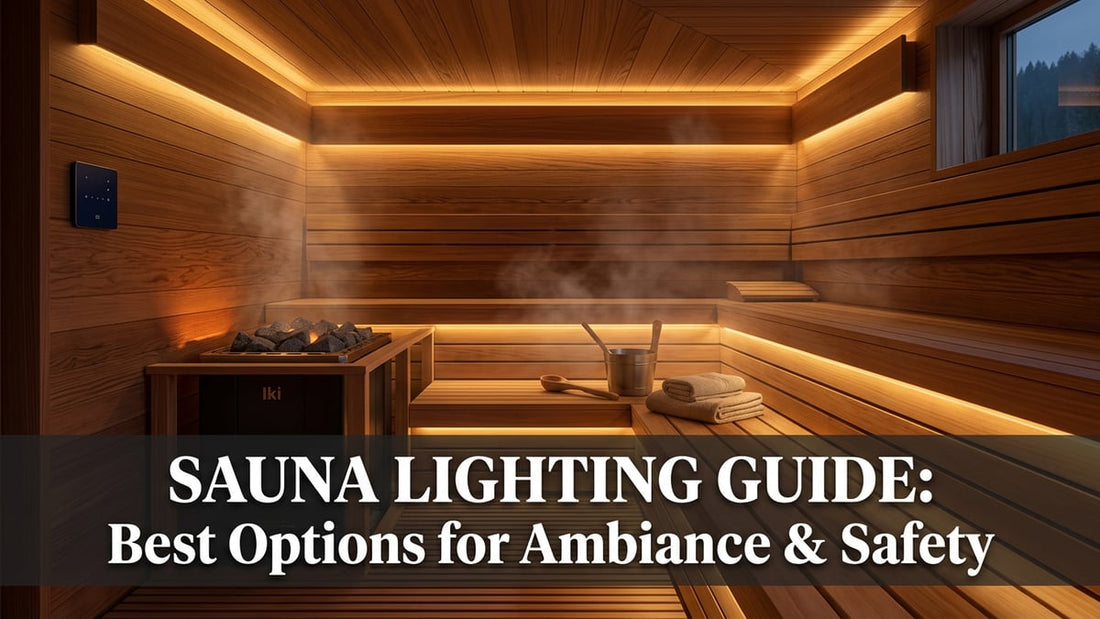
Sauna Lighting Guide: Best Options for Ambiance & Safety
Discover how the right sauna lighting can transform your wellness retreat while keeping heat, moisture, and safety perfectly in check.
Lights for sauna must be IP67-rated, heat-rated for sauna temperatures above 170°F, and wired with silicone-insulated cable. Wall sconces, recessed sauna-rated fixtures, LED strips, and valance systems each serve a distinct role. Combining two or three sources with dimmable, warm-white output around 2200 to 2700K delivers both safety and genuine relaxation.
- IP67 and heat range both required: An IP67 rating handles steam, but you also need to confirm the fixture's operating temperature range, because those are two completely separate specs.
- Stay below 2700K: Cooler, bluer light suppresses melatonin and signals alertness, so sauna lighting should stay below 2700K, ideally closer to the 1800 to 2000K range of candlelight.
- 50 to 70 degree ceiling gap: Ceiling air runs 50 to 70 degrees hotter than floor air, so fixtures and instruments both belong in the lower half of the wall, at or below bench level.
- Three-zone lighting plan: A complete plan covers interior, entry, and exterior path lighting, with each zone serving a different purpose and the entry area demanding the same IP67 rating as the interior.
- Never put the only light on the ceiling: A single ceiling fixture puts the light in the hottest part of the room, creates glare for upper-bench users, and throws shadows onto the thermometer and bench steps.
Where to start

SaunaLife E8 Sconce+ LED Light Set - Indoor-Outdoor Dimmable Fixtures, IP67 Rated, Thermo-Aspen Wood

Kohler C1 Indoor Sauna Floor Kit for C1 Five-Person Indoor Sauna
Why Lighting Is More Than an Afterthought in a Sauna
Most people put serious thought into their heater, their wood species, their benches. Lighting tends to get treated as a finishing touch, something to figure out after everything else is done. That ordering is backwards. The light in your sauna shapes the entire experience, and getting it wrong creates problems that are genuinely hard to fix once the walls are up.

The sauna environment is demanding. Temperatures regularly climb above 170°F, humidity swings dramatically when you ladle water onto the stones, and the wood itself expands and contracts with every session. Standard household fixtures simply are not built for this, and a regular LED bulb or recessed downlight that works fine in your bathroom can crack, corrode, or fail outright after a handful of uses. Beyond longevity, the wrong light ruins the mood. Harsh overhead brightness turns a relaxation ritual into something that feels like a hospital waiting room.
Good sauna lighting does two things at once: it keeps you safe by illuminating the space adequately so you can move without stumbling, and it supports the reason you are in there in the first place. Dim, warm, indirect light signals to your nervous system that it is time to slow down, which is exactly what you want from a recovery or relaxation session.
IP Ratings and Heat Resistance: What the Specs Actually Mean
Two specifications matter more than any other when you are choosing lights for a sauna: the IP (Ingress Protection) rating and the operating temperature range. The IP rating is a two-digit number where the first digit covers solid particle intrusion and the second covers water. IP67 means fully dust-tight and able to withstand temporary immersion in water. That is the rating you will see on quality sauna fixtures, and it matters because steam is more penetrating than a splash. The SaunaLife E8 Sconce+ LED set, for instance, carries an IP67 rating specifically because sauna exteriors and humid entry areas demand it.

Operating temperature range is a separate question. IP67 tells you about moisture; it says nothing about whether a fixture can handle 190°F air. Look for fixtures explicitly rated for sauna use, not just bathroom or outdoor use. A fixture rated to 140°F will degrade quickly in a hot room, even if it handles humidity fine. Manufacturers who design for saunas state an upper operating temperature in their documentation. If a listing does not mention one, that is a signal worth heeding.
Wiring is part of this too. Standard PVC-insulated cable softens and can melt under sustained heat. Silicone-insulated wiring is the industry standard for sauna installations because it remains stable at temperatures well above what you will encounter even in a very hot room. If you are having a fixture installed or retrofitting an existing sauna, confirming the wire type is not optional.
The Main Types of Sauna Lighting and Where Each One Works
Sauna lighting broadly falls into four categories: wall sconces, recessed fixtures, LED strip or valance systems, and freestanding or accent lights. Each has a legitimate use case, and most well-designed saunas combine two or three of them rather than relying on a single source.
Wall Sconces
Sconces are the most traditional choice, and they remain popular because they throw light sideways and downward rather than directly at your face. Positioned below eye level on the bench wall or near the door, they create the warm, cave-like atmosphere that makes a sauna feel like a genuine retreat. The SaunaLife E8 Sconce+ LED set uses Thermo-Aspen wood housing, which handles heat and humidity better than untreated timber, and the dimmable LEDs let you dial the intensity from task lighting down to near-darkness. That dimming range matters more than it might sound: what you want when you are walking in and getting settled is different from what you want twenty minutes into a session.
Exterior sconces serve a different purpose. If your sauna is in a backyard or outbuilding, lighting the entrance path is a safety issue, not just aesthetics. The E8 Sconce+ set is designed for exactly this application, with three 30-foot cables for flexible placement around the barrel's entrance. App-based Wi-Fi control or a handheld remote (kept in a dry location) means you can have the lights on before you even step outside.
Recessed Ceiling Fixtures
Recessed downlights are common in prefabricated saunas because they are tidy and space-efficient in a small room. The tradeoff is that ceiling placement puts them directly in a bather's line of sight when lying on the upper bench, and the ceiling is also the hottest zone in the room. Any recessed fixture in a sauna ceiling needs to be rated for that specific application. Fixtures designed for standard bathroom ceilings often are not sufficient here. That said, recessed sauna-rated fixtures paired with warm-white LEDs (around 2200 to 2700K color temperature) can produce a pleasant result, especially when dimmed.
LED Strip and Valance Systems
LED strips installed behind backrests, under benches, or along the top of the walls have become one of the most popular choices for mood lighting in saunas, and the reason is simple: indirect light is inherently more flattering and relaxing than direct light. The SaunaLife XPERIENCE-Series uses dotless LED strips mounted behind backrests, casting a soft glow that outlines the bench without creating glare. The SaunaLife ERGO-Series E Mood Color LED Valance takes a similar approach, integrating with the brand's interior lighting and app-controlled system so you can adjust color temperature or shift to chromotherapy colors without touching anything on the wall.
Chromotherapy, the practice of using colored light to support different mental states, has a genuine following in sauna culture. Research into color and mood is mixed in terms of clinical outcomes, but plenty of users find that shifting from warm amber to a soft blue or green for a cooling-down phase genuinely changes how the session feels. It costs nothing to try if the fixture already supports it.
Accent and Freestanding Options
Some users add a small accent light near the heater to highlight the stones, or a battery-powered candle-style fixture for pure ambiance. These need to be placed well away from heat sources and should never involve real flame inside the sauna. Himalayan salt lamp inserts are popular in some wellness circles, though their heat tolerance varies and they are better suited to lower-temperature zones of the room.
Color Temperature and Dimming: The Two Controls That Change Everything
Color temperature is measured in Kelvin. Daylight runs around 5000 to 6500K, standard warm white is 2700K, and the amber glow of a candle is roughly 1800 to 2000K. For a sauna, you almost always want to stay below 2700K. Cooler, bluer light suppresses melatonin production and signals alertness, which is the opposite of what a recovery session is meant to do. Research on circadian light exposure consistently shows that warm, low-intensity light in the evening hours has measurably less impact on sleep quality than the same duration under cooler light. Since many people sauna in the evening, this matters.
Dimming capability is arguably as important as color temperature. The ability to drop a fixture from 100% to 10% or lower transforms a single light source into a versatile tool. You want brighter light to check on the heater controls, read the thermometer, or help a first-time guest navigate the room safely. Then you want to drop it low once everyone is settled. The SaunaLife E8 Sconce+ achieves this via its app or remote, and the ERGO-Series valance system uses the same control platform, which means both can be adjusted together without having to manage separate switches.
Placement, Safety Zones, and the Height Rule
Where you put a light in a sauna is not purely an aesthetic decision. The room has distinct temperature zones: the air near the ceiling can be 50 to 70°F hotter than the air near the floor. Most fixtures should be positioned in the lower half of the wall, below or at bench level where possible, both because the temperatures there are more manageable and because low-level light is less intrusive. The Auroom Thermo-Hygrometer installation guidance recommends mounting the instrument 7 to 11 inches below the ceiling, which reflects how sharply temperatures stratify near the top of the room.
Safety clearances around the heater are non-negotiable. Narvi's protective wall systems, for instance, are engineered to reduce required safety distances by up to 50% around specific stove models, but that still means a meaningful exclusion zone. No fixture, cable, or mounting hardware should be within the manufacturer-specified clearance of any heater. If you are installing lighting in a wood-burning sauna, the chimney and flue routing also create zones where heat radiates outward and wiring should not run.
For outdoor barrel saunas, the entrance zone deserves its own lighting plan. Stepping out of a 180°F sauna into a dark yard and then onto wet grass or decking is where slips happen. A pair of exterior sconces at the entrance, on a separate switch from the interior lighting, lets you keep the outside lit while the inside goes dark for the last portion of your session. The three 30-foot cables included with the E8 Sconce+ set give enough reach to position fixtures at the door and along a path without needing extension wiring.
Sauna Lighting and Installation Accessories: What to Know Before You Buy
Lighting decisions do not exist in isolation from the rest of your sauna setup. The floor, the heater base, the flue system, and the monitoring instruments all interact with where and how you run wiring and position fixtures. The table below covers a range of sauna accessories relevant to a complete installation, including several items that directly affect how a lighting plan comes together.
| Product | Price | Key detail |
|---|---|---|
| Kohler C1 Floor Kit, Five-Person |
$1,031.25 | Interlocking Scandinavian spruce, 75.8" x 71.9", 1-year warranty |
 Kohler C1 Floor Kit, Three-Person Kohler C1 Floor Kit, Three-Person |
$900 | Full coverage interlocking spruce panels, matched to three-person C1 |
 Kohler C1 Floor Kit, Two-Person Kohler C1 Floor Kit, Two-Person |
$656.25 | Interlocking spruce, sized for two-person C1 sauna footprint |
 Narvi Flue 15 Chimney System Narvi Flue 15 Chimney System |
$995 | CE-certified, insulated stainless steel, fits 119mm smoke outlet |
 Narvi 550x620 Installation Base Narvi 550x620 Installation Base |
$357 | Rustproof steel, adjustable leveling legs, ensures stove alignment |
 Narvi 550x450 Floor Plate Narvi 550x450 Floor Plate |
$196 | Black stainless steel, rustproof, adjustable legs for stove base |
The flue and installation base products in that list are relevant to lighting in a practical way: a wood-burning sauna with a correctly routed Narvi Flue 15 creates predictable heat zones around the chimney, which in turn tells you where you cannot run wiring. Getting the mechanical infrastructure right first makes the electrical plan cleaner and safer. Similarly, a floor kit that installs flush and level (as the Kohler C1 series is designed to do) removes the tripping hazard at floor level that bad lighting tends to hide.
Monitoring Instruments and How Lighting Affects Them
A thermometer and hygrometer are not lighting accessories, but their placement is directly tied to your lighting plan. You need to be able to read them during a session without having to crane toward a bright light or squint in near-darkness. The Narvi Black Fahrenheit Thermometer pairs a clean aluminum face with a birch frame that sits naturally against a wood wall. The Auroom Thermo-Hygrometer reads both temperature and humidity simultaneously, which is useful if you are adjusting your steam output to hit a specific feel. Both instruments benefit from being positioned where your bench-level light reaches them without you needing to stand up.
The Narvi Smoke Flue Thermometer takes a different approach entirely: it mounts magnetically to the flue pipe and monitors exhaust temperature in real time. For wood-burning setups, this helps you run the fire at an efficient temperature without over-firing, which also protects the flue system itself. It is not a sauna interior instrument, but it is part of the monitoring picture for anyone running a wood-burning heater. You can find a full rundown of what to look for in analog versus digital thermometers and hygrometers if you are still deciding between the two approaches.
App Control and Smart Integration: Convenience With a Catch
Several of the SaunaLife lighting products use app-based Wi-Fi control, which is genuinely useful once it is set up. Being able to change brightness or color temperature from outside the sauna, or to pre-program a scene that starts automatically when the heater kicks on, reduces the number of times you are fiddling with controls while hot and sweaty. The E8 Sconce+ and the ERGO-Series valance system both use this platform, and they integrate with each other, so interior and exterior lighting can be managed as a single system.
The catch is that app-dependent systems require a stable Wi-Fi signal at the sauna location. Outdoor barrel saunas in particular can sit at the edge of a home network's range. Before committing to an app-controlled fixture, confirm your signal strength at the installation point. The E8 Sconce+ includes a handheld remote as a backup, which is a smart inclusion because it means the lights still work if the network drops. Keep the remote in a dry location away from the sauna itself, as the listing recommends.
Privacy is a minor but real consideration. Any Wi-Fi-connected fixture communicates with a server, and the security of that connection depends on the manufacturer's practices. For most home sauna users this is not a material concern, but it is worth noting if you are particular about network hygiene.
How to Build a Complete Lighting Plan for Your Sauna
A complete lighting plan for a sauna covers three zones: the interior, the immediate entry area, and any exterior path. Interior lighting should be warm (under 2700K), dimmable, and positioned at or below bench level where possible. One primary source, usually a sconce or valance strip, handles mood lighting; a secondary source near the controls or door handles visibility and safety. The two do not need to be the same fixture type.
Entry lighting serves the transition between hot interior and cooler exterior. This is where a pair of exterior sconces earns its keep, and also where IP67 rating becomes critical if the sauna is outdoors. Path lighting from the sauna door to wherever bathers cool down, whether that is a cold plunge, a shower, or simply a chair, should be on a separate circuit so it stays on even when interior lights are off.
Before you finalize any plan, walk through the sauna with the heater running and note where shadows fall on the thermometer, the heater controls, and the bench steps. Those are your functional lighting requirements. Everything else is ambiance, and ambiance is where the real quality of the session lives. The full range of sauna accessories worth having alongside your lighting includes timers, ladles, and aroma systems that collectively shape a session far beyond what any single product does alone.
For anyone browsing the broader category, the sauna accessories collection covers everything from lighting and monitoring to buckets and backrests, which makes it a useful starting point when you are equipping a new build or filling in gaps in an existing setup. If you are still deciding on the heater itself, sauna heaters span wood-burning, electric, and combined options, and the choice there has a direct bearing on how you route wiring and where your exclusion zones fall.
Common Lighting Mistakes and How to Avoid Them
The most frequent mistake is using fixtures rated for bathrooms or outdoor patios rather than saunas specifically. These may carry IP ratings that look adequate, but operating temperature ceilings of 100 to 130°F mean they are not built for the upper zones of a hot room. They may work initially and then fail or become discolored within a season.
The second most common issue is placing the only light source on the ceiling. This creates glare for anyone on the upper bench, puts the fixture in the hottest air in the room, and throws shadows onto exactly the things you need to see clearly, like the thermometer or the step between bench levels. Moving even one source to the wall changes the entire quality of the light.
Skipping dimming capability is the third mistake. A fixed-brightness fixture that works well at the start of a session often feels too bright or too harsh toward the end of one. The cost difference between a dimmable and non-dimmable sauna fixture is usually modest, and the flexibility it provides is significant. Given that sauna use is strongly associated with evening wind-down routines, the broader health reasons people use saunas regularly are best supported by a lighting environment that does not undermine relaxation or sleep preparation.
More sauna accessories worth a look

Saunum AirSolo 80 Sauna Heat Equalizing System with Himalayan Salt for Enhanced Comfort
Narvi Flue 15 - Modular Stainless Steel Chimney System for Sauna Heaters, CE Certified
Frequently asked questions
Are standard household LED bulbs safe to use inside a sauna?▾
No, standard LEDs are not built for sauna conditions. Temperatures regularly climb above 170°F, humidity spikes sharply when water hits the stones, and ordinary fixtures can crack, corrode, or fail after only a handful of sessions. You need fixtures explicitly rated for sauna use, with confirmed operating temperature ranges and silicone-insulated wiring.
What does an IP67 rating actually mean for sauna lights?▾
IP67 means the fixture is fully dust-tight and can withstand temporary water immersion, which matters because steam penetrates gaps that a simple splash would not. The SaunaLife E8 Sconce+ LED set carries an IP67 rating for exactly this reason. Keep in mind that IP67 covers moisture only, not heat tolerance, so always check the operating temperature rating separately.
How much does a quality sauna lighting set typically cost?▾
The SaunaLife E8 Sconce+ LED Light Set is priced at $495 and includes two dimmable Thermo-Aspen wood sconces, three 30-foot cables, and app-based Wi-Fi or remote control. That is a reasonable benchmark for a purpose-built, IP67-rated sauna lighting kit rather than an adapted bathroom or outdoor fixture.
What is involved in setting up sauna sconces or LED fixtures?▾
The E8 Sconce+ set includes three 30-foot cables to give you flexible placement around the sauna entrance, and control is handled via Wi-Fi app or a handheld remote stored in a dry location. That said, all electrical work inside a sauna must be completed by a licensed electrician familiar with wet-location requirements, given the combination of heat, humidity, and proximity to users.
Are sauna lights expensive to run day to day?▾
LED fixtures are among the most energy-efficient options available, and dimmable designs let you run them at lower output for the majority of a session. The SaunaLife E8 Sconce+ uses energy-efficient LEDs specifically. Exact wattage is not published in the listing, but purpose-built sauna LEDs typically draw very little power compared to the heater, which dominates your running costs.
What maintenance do sauna lights require over time?▾
Thermo-Aspen wood housings, like those on the SaunaLife E8 Sconce+, handle heat and humidity better than untreated timber, which reduces warping and surface degradation. Wipe down fixtures periodically to prevent mineral buildup from steam. Keep any remote controls in a dry location away from the sauna interior, as stated in the product guidance for the E8 Sconce+ set.
How do I know which lighting type suits the size and layout of my sauna?▾
The answer depends mainly on bench configuration and room size. Small one- or two-person rooms benefit most from wall sconces positioned below eye level, since overhead fixtures in a tight space tend to feel harsh. Larger rooms can layer sconces with LED strips under benches or behind backrests for indirect fill light. The key principle is to keep direct light sources out of the bather's sightline when lying on the upper bench.
What is the most common mistake people make with sauna lighting?▾
Treating lighting as the last decision, after the walls are already up and wiring is finished, leaves you with far fewer options. Retrofitting recessed fixtures or running concealed LED strips is much harder once panels are in place. The other frequent error is choosing fixtures rated for bathrooms or general outdoor use rather than verifying an explicit sauna-rated operating temperature, which leads to premature failure even when the IP rating looks adequate.
Shop sauna accessories
Quality inspected before shipping, with expert US-based phone support before and after purchase.
